
What Hinders Investment in the Aftermath of Financial Crises: Insolvent Firms or Illiquid Banks?
Kalemli-Ozcan, Sebnem, Kamil, Herman & Villegas-Sanchez, Carolina. How do financial crises turn into recessions? The authors of CEPR DP8543 analyze and adjudicate between two prominent explanations–the bank lending channel and the balance sheet channel. Their evidence indicates that a smaller credit supply, not the insolvency of firms, is what causes real post-crisis contractions. Πηγή: CEPR πλήρες κείμενο
Minimum Requirements for Sound Eurobonds
Kirkegaard, Jacob. Sometimes old promises come in handy. European Union Commissioner Olli Rehn must be pleased that back in June he promised to prepare a “feasibility study” before the end of the year on the topic du jour in Europe, namely eurobonds.1 As the European Commission will soon forcefully wade into Europe’s imminent and far-reaching […]
The Keynes-Hayek Rematch
Skidelsky, Robert. The Austrian economist Friedrich von Hayek, who died in 1992 at the age of 93, once remarked that to have the last word requires only outliving your opponents. His great good fortune was to outlive Keynes by almost 50 years, and thus to claim a posthumous victory over a rival who had savaged […]
Is Inflation the Answer?
Rajan, Raghu. We have just experienced financial panic. Paradoxically, a downgrade of U.S. debt has triggered a flight to liquidity towards the assets that have been downgraded. Ultimately, the cure for financial market paranoia is strong economic growth. Recently, a number of commentators have proposed a sharp contained bout of inflation as a way to […]
A three-pillar solution to the Eurozone crisis
Suarez, Javier. The current Eurozone crisis shows no sign of abating. This column proposes a solution built on three pillars: A Eurozone Charter, a Eurobond Programme, and a Debt Restructuring Programme for insolvent countries. In the current situation of the Eurozone, both the cost and the availability of market funding to financial institutions depend positively […]
Current-account imbalances: Can structural policies make a difference in Germany?
Bornhorst, Fabian & Ivanova, Anna. The German current-account surplus peaked at 7½% of GDP in 2007, coinciding with the emergence of imbalances elsewhere. This column argues that these large imbalances in large part reflected a booming world economy rather than structural factors. It adds that any sustainable rebalancing would require an ambitious reform agenda aimed at […]
What Can Replace the Dollar?
Eichengreen, Barry. For more than a half-century, the US dollar has been not only America’s currency, but the world’s as well. It has been the dominant unit used in cross-border transactions and the principal asset held as reserves by central banks and governments. But, already before the recent debt-ceiling imbroglio, the dollar had begun to […]
August 2011: The euro crisis reaches the core
Gros, Daniel. Investors are anticipating the unravelling of the 21 July 2011 “solution” and a breakdown of the interbank-market that would throw the economy into an “immediate recession” like the one experienced after the Lehman bankruptcy. This column argues that this will happen without quick and bold action. The EFSF can’t work as designed but […]
After Adam Smith: A Century of Transformation in Politics and Political Economy
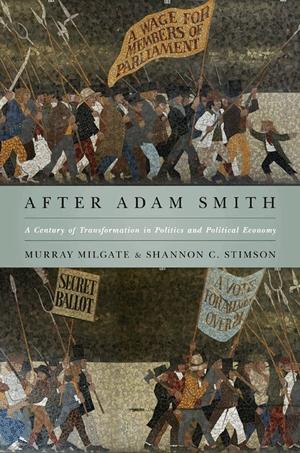
Milgate, Murray & Stimson, Shannon S. 2009. After Adam Smith: A Century of Transformation in Politics and Political Economy. Princeton and Oxford: Princeton University Press, σελ. x + 298 + index. Η σχέση οικονομίας και πολιτικής είναι, δίχως άλλο, στο επίκεντρο του σύγχρονου βίου και των παθών του και, ασφαλώς, αφορά στην ουσία της αντιπαράθεσης […]
The Manufacturing Imperative
Rodrik, Dani. We may live in a post-industrial age, in which information technologies, biotech, and high-value services have become drivers of economic growth. But countries ignore the health of their manufacturing industries at their peril. High-tech services demand specialized skills and create few jobs, so their contribution to aggregate employment is bound to remain limited. […]