

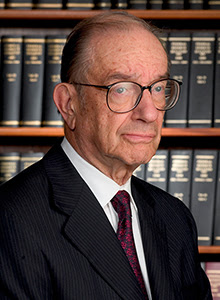
March 6, 1926 – June 22, 2026
Alan Greenspan took office as Chairman of the Board of Governors of the Federal Reserve System on August 11, 1987. He continued to serve until his fifth term expired on January 31, 2006. Greenspan died on June 22, 2026.
An interview with Alan Greenspan and his many statements and speeches are available on FRASER, the St. Louis Fed’s digital library of economic, financial, and banking materials.
Here’s a timeline of highlights:
October 19, 1987
On October 19, 1987, a day known as “Black Monday,” the Dow Jones Industrial Average dropped 22.6 percent, the largest one-day drop in stock market history.
Greenspan, who had been sworn in as Fed Chair only two months prior, delivered a statement on October 20: “The Federal Reserve, consistent with its responsibilities as the Nation’s central bank, affirmed today its readiness to serve as a source of liquidity to support the economic and financial system.”
Documents in FRASER provide a history of the event itself, including the Fed’s response.
The inflation/output tradeoff
In congressional testimony in July 1988, Greenspan stated that “monetary policy needs to be centered on making further progress toward and ultimately reaching stable prices,” defined as “a situation in which households and businesses in making their saving and investment decisions can safely ignore the possibility of sustained, generalized price increases or decreases.”
In February 1989, he explicitly noted that the Fed’s ultimate objective is “maximum sustainable economic growth over time,” where “the primary role of monetary policy in the pursuit of this goal is to foster price stability.”
At the July 1996 FOMC meeting, he responded to a question of what level of inflation no longer alters decisionmaking: “I would say the number is zero, if inflation is properly measured.”
Greenspan’s view that sustainable output growth is maximized when inflation is zero was labeled “unconventional” by some economists.
Irrational exuberance
Greenspan delivered this famous phrase on December 5, 1996, at the Annual Dinner and Francis Boyer Lecture of the American Enterprise Institute for Public Policy Research in Washington, D.C. The title of his remarks was “The Challenge of Central Banking in a Democratic Society.”
“…But how do we know when irrational exuberance has unduly escalated asset values, which then become subject to unexpected and prolonged contractions as they have in Japan over the past decade? And how do we factor that assessment into monetary policy?”
Inflation targeting
In October 2003, the St. Louis Fed held a conference on inflation targeting, where Fed governors Ben Bernanke and Donald Kohn and ECB executive board member Otmar Issing spoke on the topic.
Kohn, like Greenspan, had generally opposed inflation targeting. Bernanke, however, described an optimal, long-run inflation rate “that achieves the best average economic performance over time with respect to both the inflation and output objectives.” In his view, the FOMC could announce an explicit target, around 2 percent, provided they did not commit to a timetable for reaching it.
The conundrum
From June 2004 to February 2005, the FOMC under Greenspan increased the federal funds rate 150 basis points. Yet, the 10-year Treasury yield remained essentially unchanged. On February 17, 2005, Greenspan offered (and rejected) several possible explanations for this behavior in the Board’s semiannual monetary policy report to Congress:
“For the moment, the broadly unanticipated behavior of world bond markets remains a conundrum… it will be some time before we are able to better judge the forces underlying recent experience.”
FRASER also contains this short essay on “Fedspeak” from 2006.
Πηγή: Federal Reserve Bank of St. Louis