

An essay by Adam Tooze and Stefan Eich
The new, socialized world, the world of planning and co-operation, will come; humanity will get rid of unnecessary sufferings that are a disgrace to intelligence; and this will be achieved by a great and sober effort that has already enrolled under its banner all who have turned their backs upon a cult of musty, obscurantist, petty bourgeois sentiment. It will come; for a rational outward order of things in keeping with the present stage of human enlightenment must be created, or, if the worst happens, will be produced by violent convulsions. Only then can the heart reassert its rights with good conscience. The great sons of the bourgeois age, those whose capacity for spiritual growth raised them above the level of their class, are living proof of the fact that there are in the bourgeois nature infinite potentialities, unlimited potentialities for self-liberation and self-conquest. Our time summons the middle class to remember these innate powers and to take their stand upon them intellectually and ethically. The right to power is contingent upon the conviction that one has a historic mission to perform. If any class refuses to do this, or is too weak, it will have to step aside, abdicate power, and make way for a type that knows none of the inhibitions and ties of atavistic sentiment, which, one cannot but fear at times, may render the European middle class unfit to guide the body politic and economic into a new world.
Without doubt, the credit that history is still willing to accord to the bourgeois republic to-day—a short-term credit, indeed—rests upon the faith not yet lost that democracy also has that ability which its increasingly powerful enemies claim as their own: the ability to undertake our guidance into the new age. It is not by staging celebrations for its great sons that the middle class proves itself worthy of them. The greatest of these, Goethe, hails it:
Turn your backs upon dead trappings,
Let us love what is alive!
Whose words are these? We are in the spring of 1932. The themes are familiar. The appeal to the educated middle class standing at a turning point. The idea of living on borrowed time.
The obvious suspect is John Maynard Keynes. And yet this is clearly not Keynes. For one, if this passage was by Keynes, it would be very well-known. But it is also a little too bombastic, too European in its evocation of class categories and the reference to Goethe would be out of character too.
In fact, it is the text of a speech written by Thomas Mann speaking on the centennial of the death of his great literary hero Goethe on March 22, 1932.
Nevertheless, the resemblance in contemporary diagnosis between Keynes and Mann is intriguing. In continuation of the thought begun in Chartbook 463, it is fascinating to explore the parallels and divergences between two of the most famous liberal intellectuals of the period from the 1920s to the 1940s.
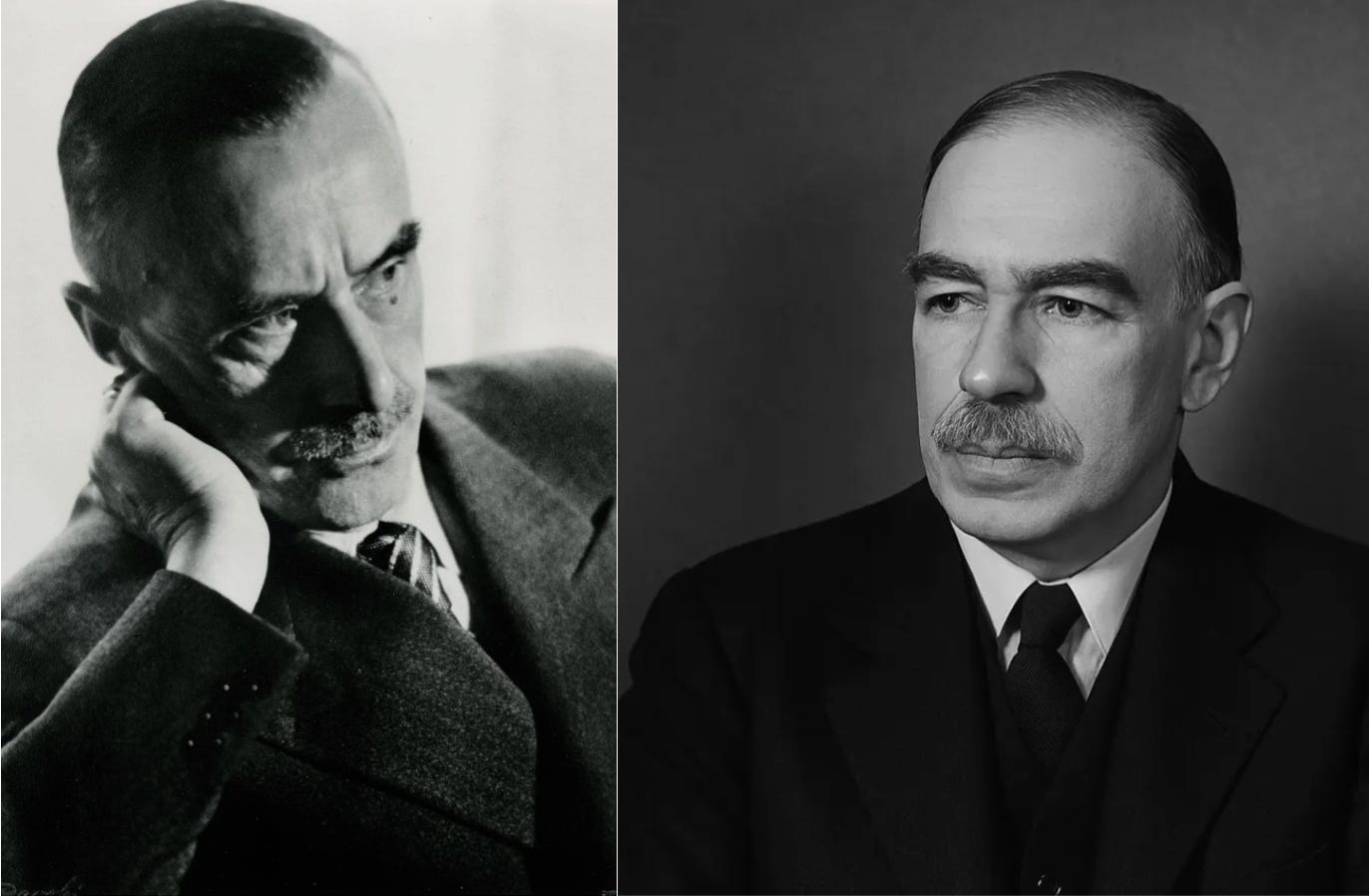
Was there contact between them? Not, as far as we know, in direct terms. So what follows is not intellectual history but speculative juxtaposition. Nevertheless, the connection is not merely imaginary.
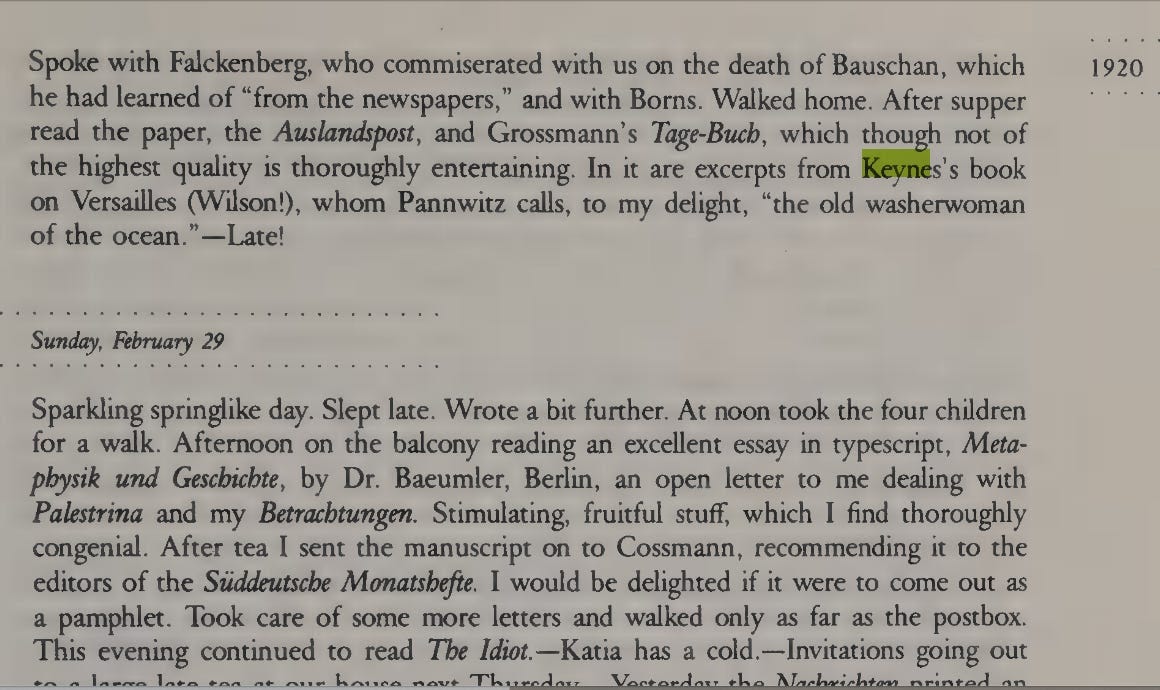
Mann can hardly have not known about Keynes. No educated German could have been ignorant of The Economic Consequences of the Peace (1919). Indeed Mann’s diary records him reading excerpts from the book in February 1920 and delighting at the portrayal of Wilson. As one would expect, Mann invokes “Keynes’s book” as a household term.
Conversely, after the critical success of Buddenbrooks (1901) and The Magic Mountain (1924), the Bloomsbury group must surely have had views about Mann, who went on to win the Nobel Prize in Literature in 1929.
And yet there is no evidence that Keynes ever read Thomas Mann. He was far more interested in Ibsen plays and Russian ballet than contemporary continental novels. It is a remarkable and perhaps telling missed connection, one that points to the relatively hermetic nature of much of middle class culture, particularly in early twentieth-century Britain.
After all, their preoccupations were deeply aligned.
Both were fundamentally interested in the fate but also the role and responsibility of the social elites inherited from the nineteenth century in the twentieth century.
Keynes’s opening to the Economic Consequences of the Peace could have come straight out of a Mann novel, except that in Mann it would have been tongue in cheek.
As Mann himself later remarked in a talk at Princeton given in 1939, Zauberberg, his great novel looking back at bourgeois life in the pre-1914 period, was only imaginable under conditions of “intact” capitalism.
For Keynes, the underlying stakes were nothing less than “civilization,” a term loaded with promise and anxiety. The force of The Economic Consequences of the Peace had after all come from treating the pre-war European order as an astonishing and fragile achievement.
In “My Early Beliefs,” the memoir Keynes read to his Bloomsbury friends in September 1938 in the midst of the Sudeten crisis, Keynes looked back on the confident rationalism of his pre-war youth and judged it “disastrously mistaken.” What he and his friends had missed was the existence of “irrational springs of wickedness in most men.” “We were not aware that civilisation was a thin and precarious crust erected by the personality and the will of a very few, and only maintained by rules and conventions skilfully put across and guilefully preserved.” It is this startling confession about the precarity of civilization that underpins Keynes’s quest for renewal and reinvention.
For the young Mann, by contrast, the same term was very nearly a slur. During World War I, and then most explicitly in his Reflections of a Nonpolitical Man (1918), he had built a whole metaphysics out of pitting “civilization” against Kultur. Civilization was the shallow, sociable, rationalizing West: epitomized by the Enlightenment, France, democracy, “literature,” even politics as such. Kultur, by contrast, was a peculiarly German thing: arising from the soul, endowed with depth, and expressed in music, form, art, indeed in the daemonic. “The difference between Geist and politics,” Mann wrote, “contains that between culture and civilization, between soul and society, between freedom and the franchise, between art and literature.” Culture was where the enchantment lived.
Having drawn this map in which enlightenment rationalism was neatly separated from the magical realm culture, within a few years he redrew it.
Already by the early 1920s Mann had dissolved the binary. In his extraordinary speech “Von deutscher Republik” (On the German Republic) given in October 1922, which startled his admirers on the right, Mann declared himself for the Weimar Republic and simultaneously insisted this was no mere recantation of his earlier beliefs. Instead, he announced by way of the unlikely duo of Novalis and Whitman “the identity of humanity and democracy,” the first being “only a classicistically old-fashioned name for the second.” Kultur and civilization, the German romantic and the American democrat. The antitheses on which his wartime Reflections had rested were now to be reconciled through the republican state and under the heading of humanity. By 1932, summoning the bourgeoisie to “guide” society into a rational new order, Mann speaks in almost exactly the civilizational register the author of the Reflections had ridiculed. That intellectual and political migration is what lets Mann’s Goethe speech begin to sound like Keynes.
By the early 1930s, theirs was thus a shared question: How do we make modern civilization work under conditions that are both affluent and yet fraught?
Like Mann, Keynes had a deep sense of inherited ideas as both powerful and out of step with the world. The profound sense that the old order was taking itself down to ruin and had to be reinvented in order to be saved, is common to both of them.
Both of them were reluctant but realistic exponents of modern democracy.
The working class as the unexpected but essential ally against bourgeois philistinism, in favor of modern intellectual and cultural progress – Mann and Keynes also agree on this.
Most fundamentally, both situated their contemporary interventions and historical reflections within a historical schema of transition.
Mann’s 1932 Goethe speech was the warrant for Georg Lukács’s claim that Mann was the “last great critical realist”. Like the modernists of his generation – Woolf, Joyce, Proust – Mann was caught up in the exploration of inner life. Under conditions of late capitalism, Lukács argued, nothing else was possible. But unlike his contemporaries, Mann remained rooted in a broader, overarching view of history, precisely the socio-economic trajectory set out in his Goethe speech: towards “(t)he new, socialized world, the world of planning and co-operation”. This meant that Mann’s Zauberberg (as argued in the last Chartbook 463) is not just a case study of subjective disorientation, but truly a structural account of the drifting apart of subjective time and objective history. This was for Lukács (and for Adorno’s btw) the essential hallmark of “realism” under conditions of late capitalism.
Taking up the Lukácsian reading, would it be too far-fetched to suggest that Keynes, in his own domain, was accomplishing something similar?
If Mann (as read by Lukács) was the last great critical realist because he accounted in grand architecture of his novels for the disintegration of the classic unity of subjective time and objective historical development, was Keynes, in his General Theory (1936), not trying to do something similar for the domain of political economy? Was Keynes not corralling the dispersed fragments of a late-nineteenth-century coherence into a new and more general framework, an intervention that was both radical and at the same time an act of preservation, not to say conservation?
Keynes’s basic diagnosis was that the old properties of a well-functioning market economy and with it the self-confident subjectivity of bourgeois identity, consumption, and personal freedom were no longer in evidence. Conservatives might insist that the only way forward was a hard-faced return to the nineteenth century. But for Keynes that amounted to a form of denial. The other great experiments of the age, the new model of 1920s Soviet civilization, as well as the distasteful centralized authoritarian regimes of Italian fascism and German Nazism, were at least able to reckon with the rupture.
But liberalism had no reason to abandon itself to this bad set of choices. If it actually occupied the space of sex-life-death – i.e. biopolitics, Mann’s preeminent domain – and at the same time situated its economic policy within an enlightened macroeconomics, framed not as a “special” case but by a “general theory” – what Mann’s novels did in narrative terms – liberalism could regain its agency and vindicate the special role of the educated elite as guiding all of society into a better and more civilized future. As both Mann and Keynes insisted, liberalism need not be shy, it need not concede the future to the fascists, so long as it put itself on the historical front foot. It must demonstrate its capacity to “guide”, as Mann put it in his Goethe speech.
That also meant accounting for one’s own vantage point in addressing a bourgeois audience. Like Keynes, Mann inhabited the contradictions of this bourgeois perspective with preternatural ease, as Lukács already observed in his essay “In Search of Bourgeois Man,” written in 1945 in honour of Mann’s seventieth birthday. Describing Mann as “the last great bourgeois writer,” Lukács highlighted his “dialectically complex attitude to the middle class.”
If we think of economics and the novel as two distinctively modern “technologies” of sense-making in bourgeois society, and if those apparatuses first took on their consolidated “classic” shape for the first time in the early nineteenth century, then both Mann and Keynes found ways to update and translate those technologies into the Age of Extremes. So, Keynes’s macroeconomic stands in relation to its Marshallian forebears, as, according to Lukács, Mann’s novels stand in relation to their nineteenth-century predecessors.
But if this parallelism is illuminating there is another deeper motif that it may unlock.
What, after all, is the pivot we are using for this speculative exercise? A speech commemorating the dominant figure of modern German culture, Johann Wolfgang von Goethe (1749-1832).
For Mann’s sense of history (and for Lukács’s reading of Mann as a historical thinker and writer) it is not just the crisis of World War I that is key. It is not by accident that in the midst of the crisis, in 1932, Mann should return to Goethe as his essential anchor point, straddling the Sattelzeit (Koselleck) between the eighteenth and nineteenth centuries. Furthermore, by way of Goethe’s own historical vista, Mann opens to the seventeenth century and the age of alchemy supposedly overcome by enlightenment rationalism. Hence the figure of Dr Faustus.
Geoff Mann (no relation) has recently given us a brilliantly illuminating reading of Keynesianism, also in terms of the Sattelzeit, but in his case by way of Hegel. This is inspired less by any specific indebtedness of Keynes to Hegel, than by Geoff Mann’s productive wrestling with Marxist readings of Keynes – above all that of Toni Negri.
In rewriting Keynes as the theorists of the thermidor, Geoff Mann gives us a tour de force in every sense of that phrase.
Our reading of Keynes in light of Thomas Mann suggests an alternative, less conservative, speculative history. On our reading, the historical depth to Mann and Keynes’s liberalism would be provided not by Hegel and his visions of the state, but by figures of bourgeois genius like Goethe and, on Keynes’s side, his great heroes of the seventeenth and early eighteenth century.
Thomas Mann’s reading of the late Goethe is worth quoting at length:
This bold, dream-like anticipation of a new society to succeed the bourgeois order is as remarkable, as impressive, as the old man’s growing interest in engineering projects of utopian scope, his enthusiasm for undertakings like the cutting through of the Isthmus of Panama. He talks of these things insistently and goes into detail as if they were of more importance to him than all the poetry in the world, and that is true, in the last analysis. His optimistic delight in the scientific side of civilization, affecting communications particularly, need cause no surprise in view of the end of Faust, who experiences his highest moment in the realization of a utilitarian dream, the draining of a swamp—a peculiar affront, indeed, to the one-sidedly aesthetic and philosophical trend of the age! In the same way, Goethe was astonishingly indefatigable in his old age in discussing the possibilities of joining the Gulf of Mexico with the Pacific, and in expatiating on the incalculable effects of such a feat upon the whole world, civilized and uncivilized alike. He wanted the United States to undertake the work, and his fancy dwells upon the prosperous cities that would spring up one after another along the Pacific coast, where nature had so felicitously prepared the ground for man by making good harbors. He could hardly wait for that to come about—that and the joining of the Danube and the Rhine, a perfectly staggering project, to be sure, along with a third very great project, the Suez Canal for the English. “To see all that,” he exclaims, “might make it worth while to hold out on this earth for another fifty years.” He cast his eyes over the earth, refusing to stop short at the borders of his own country; his enthusiasm for the future was vast enough to take in the whole world; and the quickening of life, the joys and sorrows, of foreign nations affected him as did those of his own people. His was an imperialism of love—the imperialism of an august mind risen above barriers of nationality, a mind that cherished liberty particularly under its aspect of greatness. It is the same trait that we have already seen in his heralding of a world literature. In setting itself to create a utopia of applied science, the bourgeois outlook expands to world-wide proportions; it turns into “communism,” taking that word in a sufficiently broad, undogmatic sense. This is an enthusiasm of a sober sort. But what we need to-day is the sobering of a world that is dying from the strangle-hold of emotional survivals. Who was it who said that the Germans should be prohibited from using the word “Gemüt” for fifty years? It was Germany’s greatest poet. The middle-class man is lost and is doomed to be swept aside in the era that is approaching unless he can succeed in ridding himself of the fatal sentiment and life-sapping principles that still govern his thinking. He must bravely espouse the future. It is idle to scorn reason and hold to a stubborn cult of atavistic feeling which, in present conditions, appears utterly blind and senseless—a kind of desperate, malignant, murderous sentimentalism.
It is as though Thomas Mann is reading Goethe by way of Keynes’s “Economic Possibilities of our Grandchildren”, which had been published in June 1930.
Which suggests the question – riffing this time on Geoff Mann rather than Thomas Mann – are all true Keynesians not so much descendants of Hegelian, as children of Goethe?
A textbook description of the Weimar classicism shaped by Goethe and Schiller in the transition from the eighteenth to the nineteenth century, would describe it as the synthesis of rationalism of the Enlightenment with the romantic, “animal spirits” of Sturm und Drang, a decidedly “Keynesian” formulation. An argument for Goethe over Hegel could be made simply on grounds of precedence and preeminence. By the late eighteenth century, Goethe was a cultural star of quite different proportions than Hegel. Whereas Hegel was an awed spectator of Napoleonic history, Goethe was on the young Bonaparte’s bedside table. As Emperor, Napoleon received Goethe for a personal audience in October 1808. Indeed, as Napoleonic historian Nicolas Broussard remarks:
Hegel opens his lessons on Roman history by reporting the famous bit of conversation between Goethe and Napoleon: “One day he was conversing with Goethe about the nature of tragedy. He expressed then the opinion that the modern tragedy was differing from the old one essentially in that we do not have fate any more of which men will succumb and that in the place of the ancient Fatum has appeared politics. It should thus be used as the modern destiny for tragedy, as the power of circumstances to which the individual has to bend to.” (Lectures, p.215).
Once again this is a chain of intellectual association without textual warrant in Keynes himself. The point of making it is to answer Geoff Mann’s brilliant Marxo-Hegelian reading by way of Negri with one derived from Thomas Mann by way of Georg Lukács.
Keynes, himself, might very well have been bewildered by either chain of association. After all, he situated himself self-consciously in the tradition of English political thought that descended from Hobbes and Locke. His most charged points of identification lay with figures the “nineteenth century” had flattened and which Keynes set about disinterring.
The first was Thomas Robert Malthus, almost exactly Goethe’s contemporary and, in Keynes’s insistent phrase, “the first of the Cambridge economists.” What Keynes prized in Malthus was precisely what the nineteenth century had discarded. Malthus was the road modern political economy had failed to take, defeated and buried by Ricardo. For the discipline had refused to build on Malthus the “inductive and intuitive investigator,” the mind that stayed close to the texture of experience. Instead, Ricardo’s more abstract intellectual constructionsprovedvictorious. The triumph of the cleaner, colder system produced a science remade in the misleading image of purified reason. Keynes presented his own task as revealing why the subsequent century of Ricardian dominance had been a “disaster,” stuck in an “artificial groove.”
To recover Malthus was to reopen the groove, to insist that the ancestor the nineteenth century had buried was the richer mind who had come to economic questions “by the best of all routes,” beginning as a philosopher and moral scientist, passing through history, and only then arriving at theory, as Keynes put it the biographical essay he finally published in 1933 he made the stakes plain. To describe that arrival Keynes reached for a startling image of transformation: “from being a caterpillar of a moral scientist and a chrysalis of an historian, he could at last spread the wings of his thought and survey the world as an economist.” It is an image of magic and metamorphosis: a shapeshifting creature that leaps from one fixed form into another, unrecognisable and more alive.
This was exactly the image Keynes would reach for again, on a far grander scale, when he turned from Malthus to a stranger and even more charismatic ancestor, reaching back past the eighteenth century into the seventeenth: Isaac Newton.
In 1936, Keynes, a long admirer of Newton, purchased the scientists’ unpublished manuscripts at a Sotheby auction. He reportedly paid £3,000 or around £200,000 today adjusted for inflation. As Keynes was surprised to discover, the manuscripts he had purchased reflected Newton’s extensive interest in the subject of alchemy. By Keynes’s own estimation, Newton scribbled perhaps a million words in notes on alchemical matters. As Keynes came to realize, Newton was not just the first of the scientists, but the last of the magicians.
In the remarkable commemorative essay that he penned for December 1942 the anniversary of Newton’s birth, Keynes started by apologizing for the fact that “The war has deprived me both of leisure to treat adequately so great a theme and of opportunity to consult my library and my papers and to verify my impressions … .” He then went on:
“I believe that Newton was different from the conventional picture of him. But I do not believe he was less great. He was less ordinary, more extraordinary, than the nineteenth century cared to make him out. Geniuses are very peculiar. Let no one here suppose that my object today is to lessen, by describing, Cambridge’s greatest son. I am trying rather to see him as his own friends and contemporaries saw him. And they without exception regarded him as one of the greatest of men. In the eighteenth century and since, Newton came to be thought of as the first and greatest of the modern age of scientists, a rationalist, one who taught us to think on the lines of cold and untinctured reason. I do not see him in this light. I do not think that any one who has pored over the contents of that box which he packed up when he finally left Cambridge in 1696 and which, though partly dispersed, have come down to us, can see him like that. Newton was not the first of the age of reason. He was the last of the magicians, the last of the Babylonians and Sumerians, the last great mind which looked out on the visible and intellectual world with the same eyes as those who began to build our intellectual inheritance rather less than 10,000 years ago. Isaac Newton, a posthumous child born with no father on Christmas Day, 1642, was the last wonderchild to whom the Magi could do sincere and appropriate homage.”
What is extraordinary about this essay, as about Thomas Mann’s rereading of Goethe in 1932, is its historical creativity. Keynes summons a new Newton, one freed from the encrustations of the nineteenth century. One that is both stranger and yet also more alive, freed from the wax works and thus present in the twentieth century. As one contemporary remarked, Keynes described Newton as “Copernicus and Faustus in one, and doubtless he thought he resembled them both”.
Ultimately, this is what makes Keynes and Mann kindred spirits: the ambition not only to rethink the position of the twentieth-century bourgeoisie, and its politics of liberalism in relation to the tensions of their moment, but also to give that politics a new history in the grandest sense.
Μεταφορά από: https://adamtooze.substack.com/p/chartbook-465-the-last-of-the-magicians